
Intern Project
William Frank

Dartmouth University • Freshman
Qualitative Traction Radar (QTR)
The Qualitative Traction Radar (QTR) is an automated intelligence system designed to evaluate early-stage companies through real-time analysis of customer sentiment and market signals across the internet. Rather than relying on static founder narratives or incomplete quantitative metrics, QTR continuously aggregates, structures, and interprets qualitative data to assess product-market fit, emerging risks, and conviction trends.
The workflow ingests company inputs, then systematically discovers and monitors relevant data sources across platforms such as Reddit, Twitter, Product Hunt, LinkedIn, and broader web content. It extracts user-generated discussions, reviews, and commentary, and applies natural language processing to identify key signals including emotional intensity, switching behavior, product satisfaction, and recurring pain points.
By transforming unstructured market sentiment into structured, decision-ready insights, QTR enables investors to identify high-conviction opportunities earlier, ask sharper diligence questions, and track evolving company trajectories with an always-on signal layer that traditional metrics cannot capture.
The workflow was developed using Claude Code through n8n’s platform, leveraging an Apify Web Scraper to access specialized corners of the internet alongside Claude Web Search for general queries. The pipeline connects to Notion AI for note-taking and table formation, and integrates with Google’s API platform for additional functionality.
▶Qualitative Traction Radar (QTR) — UI Images
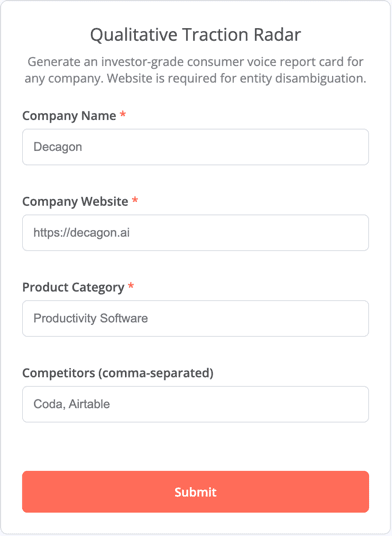
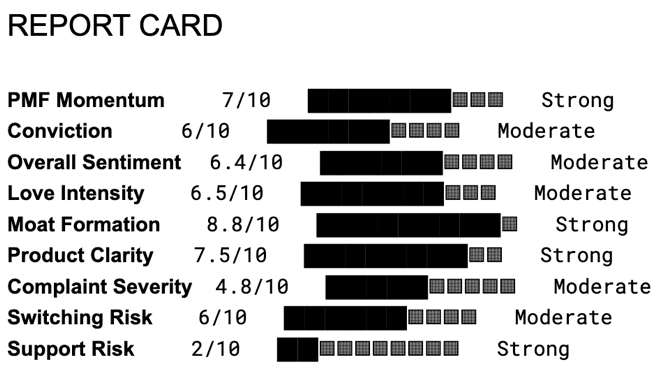
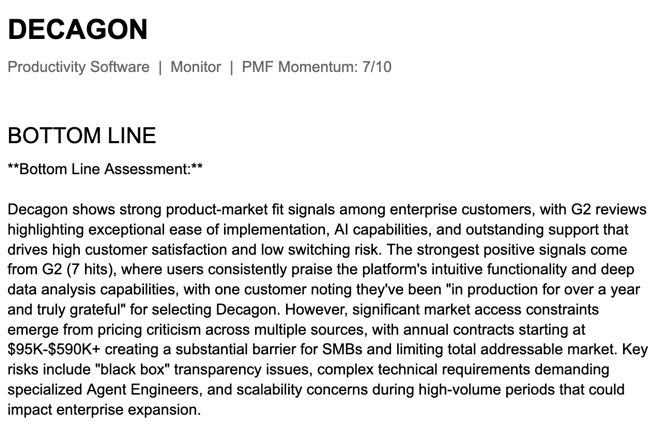
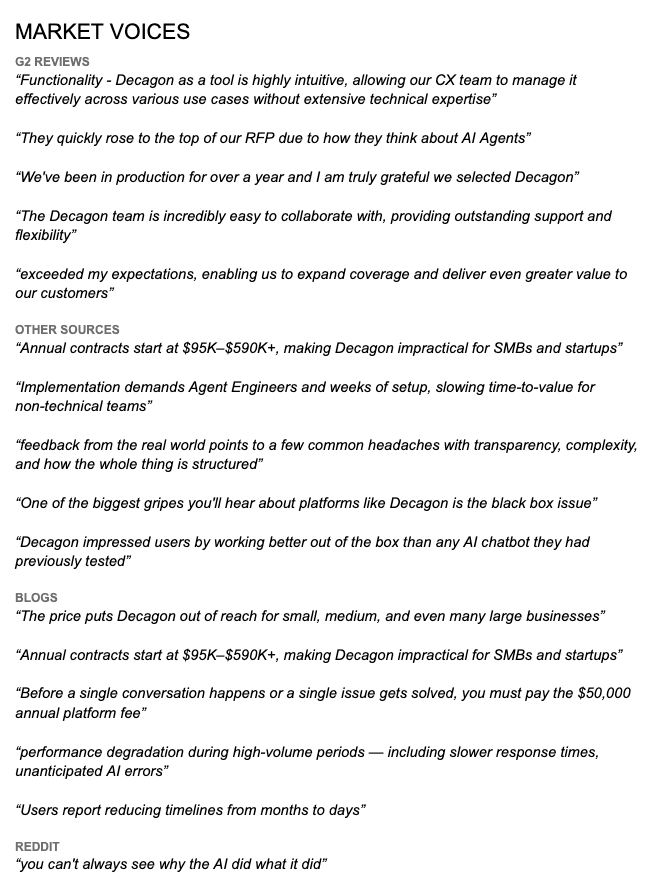
Inputs
- Company name (required)
- company website (required)
- product category (required)
- competitor (optional, comma-separated)
Outputs
- Google Doc with bottom line assessment (PMF synthesis, strengths, risks, investment signal)
- report card with quantitative ratings across PMF momentum, conviction, sentiment, moat formation, switching risk, and support risk
- curated market voices from G2, blogs, Reddit, and public sources
- aggregated key themes (strengths and weaknesses)
- recommendation (Accept, Monitor, or Pass)
- Notion table with structured company data including scores, data quality, sources, and tier classification
About William Frank
William Frank is a freshman at Dartmouth University. At Visible Ventures, he built an automated intelligence system that translates unstructured customer sentiment into structured, decision-ready insights for early-stage company evaluation.
“This internship has been a transformative experience. I’ve gained firsthand insight into how LLM-powered research operates and how AI can meaningfully reduce friction points across venture capital workflows. That exposure has allowed me to pursue my own initiatives exploring AI as a creative and analytical tool, knowledge that I am confident will prove invaluable as AI continues to reshape the industry.”
— William Frank